Want To Get The Latest Catalogue?
Finding an artificial flower supplier in China is easy. Finding one you can trust with your brand, your deadlines and your money is not.
China produces the majority of the world’s artificial flowers. Thousands of suppliers advertise factories — but many are trading companies with an office, a catalog and a phone number. Both can ship flowers. Only a real factory controls quality, cost and delivery from the first batch to the hundredth.
This guide shows you how to separate real factories from middlemen, how to verify a supplier before you pay, and what to put in your agreement so your first order is also your best order. It is written from the perspective of a direct manufacturer (Blush-Rose has run its own artificial flower factory in Wuqing District, Tianjin since 2008), and it applies to any supplier you evaluate.
First, Understand the Supplier Landscape
China’s artificial flower industry clusters in a few production areas, each with different strengths:
- Yiwu, Zhejiang — the world’s largest small-commodity market; huge variety, very competitive pricing, many traders and market stalls
- Tianjin & North China — established flower factories with export experience and OEM/ODM capability
- Guangdong (Shenzhen, Guangzhou) — fast supply chains, strong electronics-adjacent manufacturing, good for time-sensitive orders
- Jiangsu & Shandong — textile-based flower production, strong on silk and fabric flowers
Where you find a supplier matters less than what you verify. A good factory exists in every cluster; a bad trader exists too.
Factory or Trading Company? Look for These 7 Signals
A trading company can sound exactly like a factory — until you ask the right questions. Use this checklist:
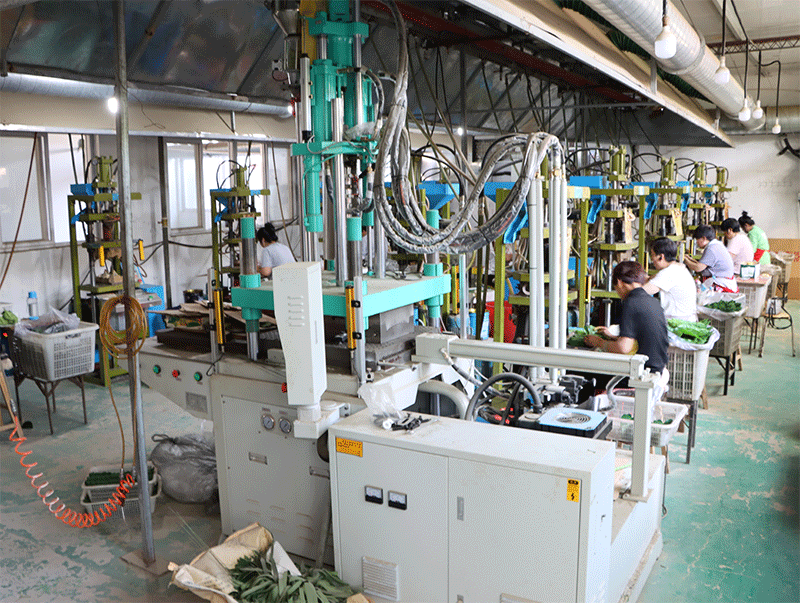
- Video call to the workshop. A real factory can show you production lines, molding machines, raw material storage and packing areas on a live call. A trader will hesitate, offer pre-recorded videos, or show you “a partner’s factory”.
- Mold and tooling ownership. Ask how many mold sets the supplier owns. (Blush-Rose owns 200+ sets of molds covering 200+ product categories.) Molds are the factory’s core asset — a trader owns none.
- Raw material partners. Factories buy fabric, wire, paint and glue directly from material makers. Ask for the names of their raw material suppliers. (We cooperate with 20+ material manufacturers.)
- QC records. Ask to see in-process inspection records, defect statistics or a final inspection report from a recent order. A factory can produce these; a trader cannot.
- Price behavior. A factory quotes based on material cost, mold amortization, labor and packing — prices move slowly and rationally. A trader’s prices bounce around with their supplier’s mood.
- Answer depth. Ask a technical question: “What is the difference between brushed polyester and flocked fabric for outdoor use?” A factory answers with specifics. A trader gives you a brochure sentence.
- MOQ flexibility. A factory that owns its lines can accept a low MOQ test order. A trader usually needs to fill a container to make margins.
You can skip the “how many workers do you have” question — numbers are easily faked. The signals above are much harder to fake.
Verify Before You Commit
Once a supplier passes the initial screen, do official and third-party checks:
- Business license — request the full Chinese business license. Check the registered address against the factory address they give you. A factory’s license says “manufacturing”; a trader’s says “import/export” or “sales”.
- Export qualifications — valid export license and customs registration; ask for their customs declaration numbers on recent shipments.
- Third-party audits — BSCI, SGS, BV or TÜV reports add credibility. Even without a report, an audit invitation (“we welcome your inspector or a third party at any time”) is a strong signal.
- Trade references — ask for 2–3 customer references in your market or a similar market, and actually contact them.
- Search footprint — a supplier that has shipped to 100+ countries, appears in trade directories and maintains its own website with consistent details is easier to trust than a supplier with zero trace.
Order Samples Before Anything Else
Samples are the cheapest insurance in sourcing.
Request 3–5 items that represent the range you plan to buy. Check each against the 7-point quality checklist in our guide How to Evaluate Artificial Flower Quality Before You Place a Wholesale Order.
What to agree on with samples:
- Sample fee and courier cost (many factories, including Blush-Rose, ship samples before a bulk order; sample fees are usually deducted from the first order)
- Whether the bulk product must match the sample exactly (yes — make them say it)
- A golden sample: keep one unit signed by both sides as the reference for the whole order
Understand MOQ and How Factory Pricing Works
A direct factory’s price breaks down roughly into: raw materials + mold/tooling amortization + labor + packing + overhead + (small) margin. Knowing this helps you negotiate intelligently:
- MOQ: real factories offer reasonable MOQs. Blush-Rose accepts low MOQs and small test orders so new buyers can verify quality before scaling up.
- Mold costs: custom designs require new molds. Ask whether the mold fee is one-time and whether it is refundable against order volume.
- Quantity breaks: prices improve at volume tiers (e.g., 1,000 / 5,000 / 20,000 units). Ask for the full price ladder, not one quote.
- Be careful with “too good” prices: if a quote is far below the material cost of what you asked for, the supplier will make up the difference somewhere — thinner fabric, weaker wire, lighter packing.
Put Everything in Writing: QC, Defects and Payment
Verbal agreements disappear when problems arrive. Before production, confirm in writing:
- Golden sample + photos + measurements as the quality reference
- Defect list: critical / major / minor defects and the acceptance rate (e.g., AQL 2.5 or your own standard)
- Inspection: your own inspector or a third party (SGS, BV) can check before shipment; agree who pays and what happens on failure
- Payment terms: common options are 30% deposit / 70% balance against copy of B/L, or T/T with a deposit; L/C for larger orders. A factory that insists on 100% payment before production deserves extra scrutiny
- Lead time: production time, packing time and the shipping date, with penalties or remedies for delay if it matters to your season
- Design protection: for custom OEM/ODM designs, sign an NDA and confirm the molds and designs stay yours; keep your design files off public channels
Plan the Logistics Early
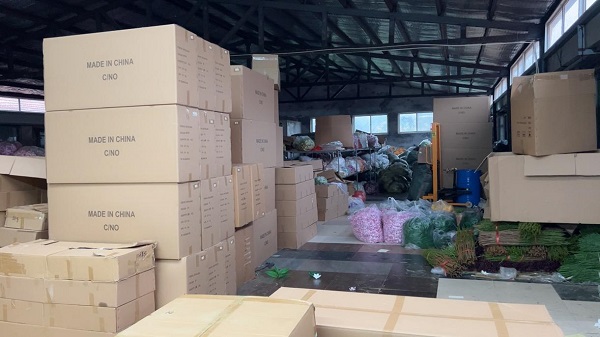
Flowers are light but bulky — freight cost can rival product cost.
Ask for complete carton specifications on every item: inner pack quantity, master carton size, gross weight and net weight, and units per carton. Use them to calculate the container loading plan and your landed cost before you commit. A factory that provides full 箱规 (carton spec) data is a factory that has shipped before.
Typical sea freight from China: 20–35 days to Europe, 25–40 days to North America, depending on the port and season. Order early for peak seasons (wedding season, Valentine’s Day, Mother’s Day, Christmas) — capacity and freight prices both surge.
Red Flags: A Quick Pre-Order Checklist
Avoid suppliers who:
- Refuse a live workshop video call
- Cannot name their mold count, material suppliers or QC process
- Quote prices that change weekly
- Demand full payment before production with no inspection option
- Have no traceable export history or customer references
- Promise “exactly like the photo” but avoid sending physical samples
- Have a website or catalog full of copied images from other factories
Why Choose a Factory-Direct Manufacturer
Buying from the factory means one fewer link in the chain — one fewer place for quality to drop and price to rise.
Blush-Rose (ASDA Technology (Tianjin) Co., Ltd) has manufactured artificial flowers in Tianjin, China since 2008. What you get from us:
- Factory-direct: our workshop, molding and QC are all in-house; we respond to inquiries within 24 hours
- Scale: 200+ mold sets, 200+ product categories, shipped to 100+ countries
- Quality control: incoming material checks, in-process control and final inspection on every batch
- OEM/ODM: custom colors, sizes, stems, packaging and private labels, with hundreds of mold patterns to choose from
- Low-risk entry: samples before bulk orders and low MOQ test orders
Frequently Asked Questions
How can I verify that a supplier is a real factory?
Ask for a live video call to the workshop, their business license with a matching registered address, mold ownership numbers, QC records, third-party audit reports and customer references.
What is the difference between a factory and a trading company?
A factory owns production lines, molds and materials, and controls quality and cost directly. A trading company buys from factories and resells, adding cost and a layer of distance between you and the actual producer.
What is the typical MOQ for artificial flowers?
It varies by item and supplier. Direct factories often accept low MOQs and small test orders; Blush-Rose supports test orders so you can verify quality before scaling up.
Can I get samples before placing a bulk order?
Yes. Reputable suppliers ship samples first, and sample fees are usually deducted from the first bulk order.
What payment terms do artificial flower suppliers accept?
Common terms are 30% deposit with the balance against the bill of lading, T/T with a deposit, and L/C for larger orders. Be cautious with suppliers demanding 100% payment before production.
How do I protect my design when ordering custom flowers?
Sign an NDA, keep molds and design files under your ownership, and agree in writing that the factory will not reproduce your design for other buyers.
Get a Quote
Ready to start with a sample order or a test order? Contact us:
- Email: enquiry@blush-rose.com
- WhatsApp / Tel: +86 139 2007 7206
- Browse our artificial silk flowers collection for wholesale options
Blush-Rose (ASDA Technology (Tianjin) Co., Ltd) — factory-direct artificial flower manufacturer since 2008. 200+ molds, 200+ categories, 100+ countries.
